Among the most eloquent documents of Egyptian magic are objects that were destroyed on purpose. Clay pots and statuettes of clay or stone, covered in names written in ink, were smashed and buried. Egyptologists call them execration texts: lists of enemies, foreign and Egyptian, whom the rite was meant to render powerless. These are not private acts of revenge but a state magic that defended the order of the country.
What they contain
Execration texts follow a recurring pattern. They list:
- foreign rulers and peoples, especially from Nubia, Libya and the Syro-Palestinian region, often with their personal names;
- Egyptians regarded as rebellious or dangerous, named individually and sometimes with their mother's name;
- generic hostile forces: "every evil word, every evil speech, every evil plot, every evil dream".
This last category is the most interesting. The enemy is not only a person with an army, but also the thought, the word and even the dream that might threaten harmony. The rite aimed to neutralise disorder in all its forms.
The objects of the rite
The red pots
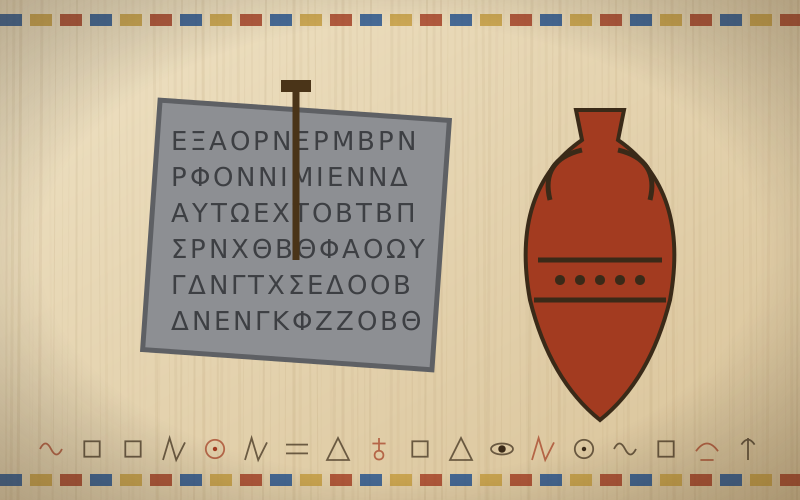
One of the best-known forms is the red earthenware pot inscribed with names and then shattered. In Egypt red was the colour of Seth and of dangerous forces: writing enemy names on a support of this colour already placed them within the sphere of chaos. The act of breaking the pots also appears in funerary rites and is attested in the spells of the Pyramid Texts.
The prisoner figurines
At other times the names were written on statuettes showing a kneeling man with his arms tied behind his back. This is the same iconography as the defeated enemy beneath the pharaoh's sandals or on the steps of thrones. The figurine was a substitute for the enemy: what happened to the image was meant to happen to the person or people named.
Where they have been found
Groups of execration texts come from several sites, mainly of the Old and Middle Kingdoms:
| Place | Type of find |
|---|---|
| Giza necropolis | Inscribed figurines placed near tombs |
| Saqqara | Statuettes and fragments with lists of names |
| Thebes | Fragmentary pots now kept in European museums |
| Mirgissa (Nubia) | A large ritual deposit near a fortress |
The deposit at Mirgissa, near one of the Egyptian fortresses of the Second Cataract, is the most striking. It included hundreds of fragments of red pots, clay figurines, flint objects and, in a nearby pit, human remains that many scholars connect with the rite itself. It is rare evidence of how serious and concrete this practice could be at the borders of the kingdom.
How it worked, symbolically
The principle is the one that runs through all of Egyptian magic: the name is an essential part of a being. Writing an enemy's name, then breaking, binding, piercing or burying it, was equivalent to acting on that person's existence. The ritual actions could include:
- writing the names in ink, often in hieratic;
- breaking the support while reciting spells;
- trampling, piercing or binding the figurines;
- burial in a place connected with death, such as a necropolis.
Each gesture had a meaning: breaking separated, burying shut the enemy in the underworld, fire annihilated him.
A royal magic
Execration texts were closely bound up with kingship. The pharaoh's task was to uphold Maat, cosmic and social order, against the chaos pressing in from every side. Military campaigns, triumphs carved on temple walls and execration rites were three different languages expressing the same duty. Magic did not replace the army: it accompanied it, extending the country's defence onto the invisible plane.
This is why the lists also include "possible" enemies. They named not only those who had already attacked, but anyone who might do so in the future. The rite had a preventive function, like a seal set around the borders.
Later echoes
The idea of acting on an enemy through his written name did not disappear. In temples of the Late Period rites were performed against Apophis, the serpent of chaos, by destroying his image; in the Graeco-Roman age, the curse tablets of the Mediterranean world follow a similar logic, though they arose in different settings. At Studio Esoterico Cornelio these documents are read for what they are: historical witnesses to a worldview in which writing, gesture and word formed a single action.
Their value for scholars
Beyond their religious meaning, execration texts are a precious historical source. The lists of foreign princes and towns provide information on the political geography of Nubia and the Levant in an age for which written sources are scarce. An object made to erase a name ended up preserving it for millennia.
In short
- Execration texts are pots and figurines bearing enemy names, broken and buried.
- The lists include foreigners, rebellious Egyptians and abstract forces such as evil words and dreams.
- The red of the pots and the bound prisoner figure place the enemy in the sphere of chaos.
- The Mirgissa deposit in Nubia is the largest and most striking find.
- They were a royal magic serving Maat, and today also a historical source on neighbouring peoples.