In Roman Egypt, while the traditional temples steadily lost resources and prestige, priests went on copying and reworking ancient ritual knowledge. One of the richest documents of this phase is the Demotic Magical Papyrus of London and Leiden, a long manual written in the third century AD. It is now divided into two parts, kept in the British Museum and in the National Museum of Antiquities in Leiden, hence its name.
Origin and features
The papyrus very probably comes from Thebes and belonged to a group of magical and alchemical manuscripts bought in the nineteenth century by the collector Giovanni Anastasi. The same group also included papyri in Greek, now part of the collection of the Greek Magical Papyri.
The text has three notable features:
- it is written mainly in Demotic, the latest Egyptian cursive script;
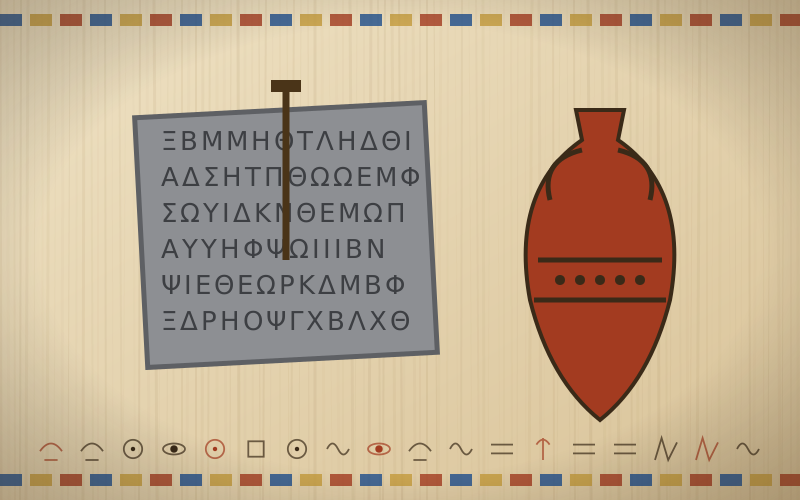
- many foreign words or divine names are accompanied by Old Coptic glosses, that is, Greek letters used to indicate the exact pronunciation;
- some passages are in Greek, and others are written in cipher signs.
The pronunciation glosses show how important it was to say the words correctly. Sound mattered as much as meaning.
Divination with bowl and lamp
The largest part of the papyrus concerns divination, that is, rites for obtaining a vision or an answer from the gods.
| Technique | Technical name | Description |
|---|---|---|
| Bowl of water and oil | Lecanomancy | Watching the surface of the liquid for a vision |
| Lit lamp | Lychnomancy | The vision appears in the flame or light of the lamp |
| Direct vision | Autopsia | The petitioner himself sees and hears the god |
| Dream | Oneiromancy | The answer comes during sleep |
In many cases the rite is carried out with the help of a boy acting as medium: it is he who looks into the lamp or bowl and reports what he sees. The child had to be pure, that is, not yet an adult, a condition also required in other ancient traditions of divination.
Preparing the rite
The instructions are very precise. They specify:
- the place, often a dark, clean room, oriented in a certain way;
- the lamp, new and with a wick of pure linen;
- the oil or substances to be used;
- the words to be recited, repeated a set number of times;
- the formulas of dismissal, to send the god back to his place once the answer has been obtained.
The last point is significant: the rite does not end with the vision, but with the dismissal, which re-establishes the distance between the human and divine worlds.
Anubis, guide of the vision
The most prominent deity is Anubis, the jackal god. In the spells he is invoked to go and summon the gods, open the doors of vision and let the light in. Anubis's role as guide between worlds, already ancient in funerary religion, is here transferred to divination: as he accompanied the dead, so he accompanies the vision.
Alongside him appear Osiris, Isis, the sun and numerous foreign divine names, some of Greek or Semitic origin, a sign of the cosmopolitan setting in which the text was composed.
Other contents
Besides divination, the papyrus includes spells for gaining favour, love spells, instructions for sending dreams and a series of recipes using plants, minerals and animal parts. These last should be read as historical documents of ancient analogical thinking, not as practical directions: each substance had a symbolic value tied to myth or to colour.
A bridge between two worlds
The London and Leiden papyrus is valuable because it shows the continuity between Egyptian priestly magic and the magical papyri in Greek. Many rituals resemble one another, and the shared core suggests that the same circles produced texts in both languages. Maestro Cornelio considers it one of the key documents for understanding how ancient Egypt passed on its ritual knowledge to the late antique world, from which it would later reach the Hermetic traditions.
In short
- The Demotic Magical Papyrus of London and Leiden dates to the third century AD and is split between two museums.
- It is written in Demotic, with Old Coptic glosses giving the exact pronunciation.
- Its main section concerns divination with lamp, bowl and dream.
- The rite often uses a boy as medium and ends with the dismissal of the god.
- Anubis is the guide of visions, and the text shows continuity with the Greek magical papyri.